- Publication Number: 397493
- Publication Date: 9th October 2025
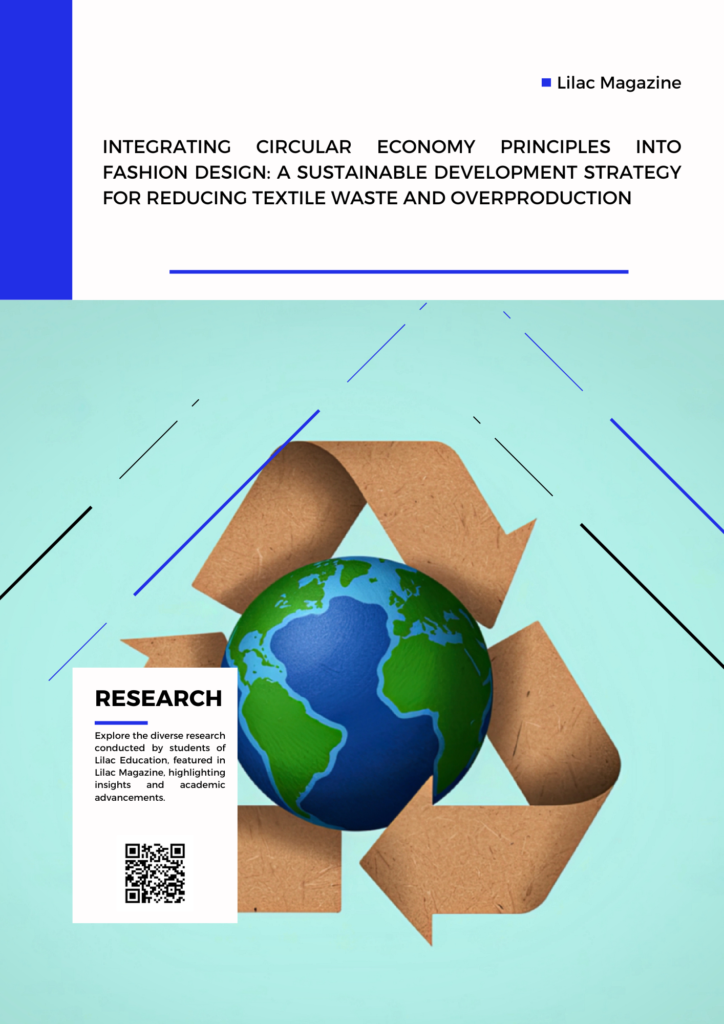
Integrating Circular Economy Principles into Fashion Design: A Sustainable Development Strategy for Reducing Textile Waste and Overproduction
Author: ARPITA PROVAKOR | ID: 27199320190102018
Reviewed by:
Lilac School of Fashion (LSF)
Paper preview
1. Abstract
2. Introduction
3. Literature Review
4. Methodology
5. Findings
6. Conclusion
7. References
Abstract
The global fashion and textile industry is one of the most resource-intensive production systems, contributing significantly to textile waste, overproduction, water consumption, and environmental pollution. Industry reports consistently indicate that a large share of garments are discarded within a short period of use, while surplus production and inefficient design practices continue to strain natural resources. In response to these challenges, this study explores how circular economy principles can be systematically integrated into fashion design as a sustainable development strategy. The research examines the relationship between design decisions, material selection, and production cycles, emphasizing how early-stage design choices influence waste generation throughout a garment’s life cycle. Using a qualitative, literature-based and case-informed approach, the study analyzes circular economy concepts such as durability-focused design, material efficiency, reuse, recycling, and waste minimization within fashion production systems. Observations from export-oriented garment manufacturing contexts, particularly in developing economies, are used to connect theory with real-world industry practices. The findings suggest that incorporating circular economy principles at the design and planning stages can substantially reduce textile waste and overproduction while maintaining economic feasibility for manufacturers. The study also highlights that design-level interventions alone are insufficient without supportive governance frameworks, responsible supply-chain management, and policy-driven incentives that encourage sustainable production and consumption. Furthermore, the research emphasizes the role of industry accountability and institutional coordination in scaling circular practices beyond individual firms. Overall, this study demonstrates that integrating circular economy principles into fashion design can support sustainable development goals by reducing environmental impact, improving resource efficiency, and promoting long-term industry resilience. The findings contribute to ongoing discussions on sustainability transitions in industrial sectors and provide practical insights for designers, manufacturers, and policymakers seeking evidence-based solutions for a more sustainable fashion industry.
References
Bocken, N. M. P., de Pauw, I., Bakker, C., & van der Grinten, B. (2016). Product design and business model strategies for a circular economy. Journal of Industrial and Production Engineering, 33(5), 308–320. https://doi.org/10.1080/21681015.2016.1172124
Ellen MacArthur Foundation. (2017). A new textiles economy: Redesigning fashion’s future. https://ellenmacarthurfoundation.org
Ellen MacArthur Foundation. (2020). Circular economy in fashion. https://ellenmacarthurfoundation.org
Fletcher, K. (2014). Sustainable fashion and textiles: Design journeys (2nd ed.). Routledge.
Fletcher, K., & Grose, L. (2012). Fashion and sustainability: Design for change. Laurence King Publishing.
Geissdoerfer, M., Savaget, P., Bocken, N. M. P., & Hultink, E. J. (2017). The circular economy–A new sustainability paradigm? Journal of Cleaner Production, 143, 757–768. https://doi.org/10.1016/j.jclepro.2016.12.048
Global Fashion Agenda. (2020). Fashion on climate. https://www.globalfashionagenda.com
Kirchherr, J., Reike, D., & Hekkert, M. (2017). Conceptualizing the circular economy: An analysis of 114 definitions. Resources, Conservation and Recycling, 127, 221–232. https://doi.org/10.1016/j.resconrec.2017.09.005
Koszewska, M. (2018). Circular economy—Challenges for the textile and clothing industry. Autex Research Journal, 18(4), 337–347. https://doi.org/10.1515/aut-2018-0023
Niinimäki, K. (2017). Fashion in a circular economy. Sustainability, 9(5), 743. https://doi.org/10.3390/su9050743
Niinimäki, K., Peters, G., Dahlbo, H., Perry, P., Rissanen, T., & Gwilt, A. (2020). The environmental price of fast fashion. Nature Reviews Earth & Environment, 1(4), 189–200. https://doi.org/10.1038/s43017-020-0039-9
OECD. (2020). Global material resources outlook to 2060. OECD Publishing. https://doi.org/10.1787/9789264307452-en
Pal, R., & Gander, J. (2018). Modelling environmental value: An examination of sustainable business models within the fashion industry. Journal of Cleaner Production, 184, 251–263. https://doi.org/10.1016/j.jclepro.2018.02.001
Sandin, G., & Peters, G. M. (2018). Environmental impact of textile reuse and recycling. Journal of Cleaner Production, 184, 353–365. https://doi.org/10.1016/j.jclepro.2018.02.266
Stahel, W. R. (2016). The circular economy. Nature, 531(7595), 435–438. https://doi.org/10.1038/531435a
United Nations Environment Programme. (2018). Putting the brakes on fast fashion. https://www.unep.org
United Nations Environment Programme. (2020). Sustainability and circularity in the textile value chain. https://www.unep.org
United Nations. (2015). Transforming our world: The 2030 Agenda for Sustainable Development. https://sdgs.un.org
van der Velden, N. M., Patel, M. K., & Vogtländer, J. G. (2014). LCA benchmarking study on textiles. Journal of Cleaner Production, 72, 254–263. https://doi.org/10.1016/j.jclepro.2014.02.049
Wang, Y., & Shen, B. (2017). Sustainable fashion supply chain management. Sustainability, 9(9), 1572. https://doi.org/10.3390/su9091572
Wiedemann, S. G., Biggs, L., Nebel, B., Bauch, K., Laitala, K., Klepp, I. G., & Swaney, D. P. (2020). Environmental impacts of garments. Sustainability, 12(13), 5410. https://doi.org/10.3390/su12135410
Zamani, B., Sandin, G., & Peters, G. M. (2017). Life cycle assessment of clothing libraries. Journal of Cleaner Production, 162, 1368–1375. https://doi.org/10.1016/j.jclepro.2017.06.128
European Commission. (2022). EU strategy for sustainable and circular textiles. https://environment.ec.europa.eu
Fletcher, K., & Tham, M. (2019). Earth logic: Fashion action research plan. J. J. Charitable Trust.
Birtwistle, G., & Moore, C. M. (2007). Fashion clothing—Where does it all end up? International Journal of Retail & Distribution Management, 35(3), 210–216. https://doi.org/10.1108/09590550710735068
Keywords
Circular Economy, Sustainable Fashion, Textile Waste Reduction, Sustainable Development, Fashion Production Systems
All rights to Lilac Magazine are exclusively reserved under the Lilac Group of Companies, ensuring full copyright protection for all published content. As part of its commitment to fostering academic excellence, Lilac Group provides extensive research facilities for Lilac Education students, Lilac Group employees, members, and individuals dedicated to innovation and advanced research. Researchers can also access authentic primary data and verified factual information through Lilac Survey Company and its affiliated entities, facilitating accurate research and data-driven analysis. To obtain the full research paper, interested readers must submit a request with the LMRPID (Lilac Magazine Research Paper ID) via email at lilacpublication@gmail.com. A subscription fee of $100 USD applies, supporting research funding and academic scholarships awarded to dedicated researchers who demonstrate exceptional passion and commitment to their fields. To maintain the highest scholarly standards, Lilac Magazine ensures that all published research meets strict quality control measures, with data accuracy verification and a Turnitin plagiarism check (ensuring less than 10% similarity) along with minor grammatical refinements.