- Publication Number: 397495
- Publication Date: 20th October 2025
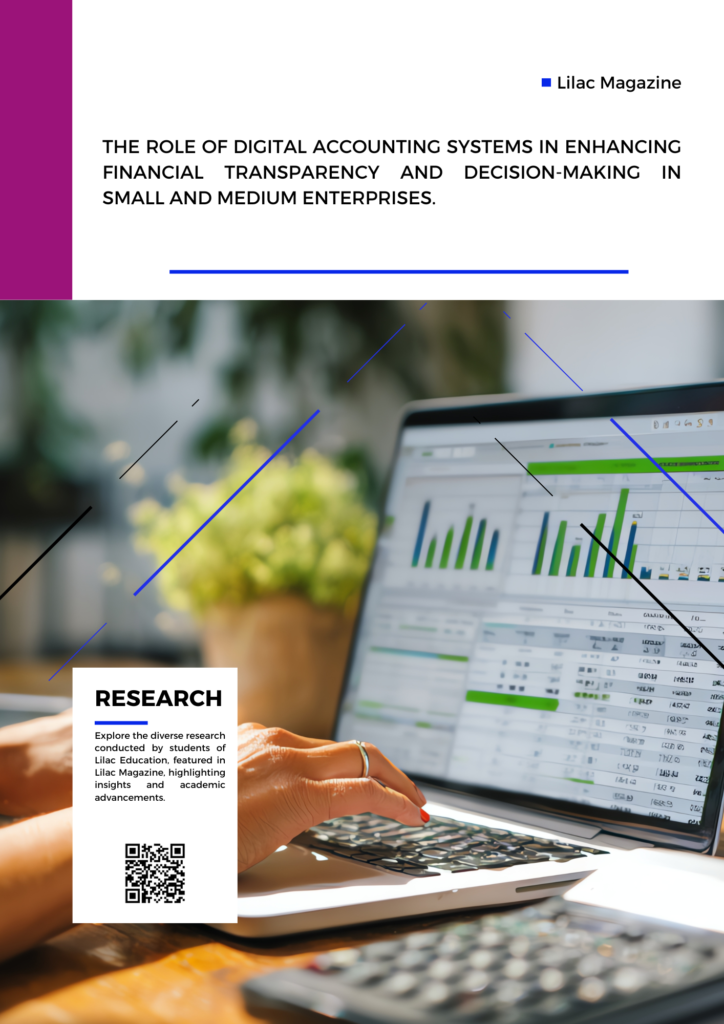
The Role of Digital Accounting Systems in Enhancing Financial Transparency and Decision-Making in Small and Medium Enterprises.
Author: FARIHA AFRIN KANTA | ID: 27199320190102026
Reviewed by:
Lilac School of Business (LSB)
Paper preview
1. Abstract
2. Introduction
3. Literature Review
4. Methodology
5. Findings
6. Conclusion
7. References
Abstract
The rapid advancement of digital technologies has significantly transformed traditional accounting practices, particularly within Small and Medium Enterprises (SMEs). This study explores the role of digital accounting systems in enhancing financial transparency and improving decision-making processes in SMEs. As businesses increasingly shift from manual to automated accounting systems, the need for accurate, timely, and reliable financial information has become more critical than ever. This research aims to examine how integrating digital accounting tools improves financial reporting, operational efficiency, and strategic management. The study adopts a qualitative, analytical approach, drawing on existing literature, real-world business practices, and observed accounting frameworks within SMEs. It highlights how digital accounting systems minimize human error, streamline financial transactions, and provide real-time financial data, thereby supporting informed managerial decisions. Furthermore, the research emphasizes that enhanced financial transparency not only strengthens internal control mechanisms but also builds trust among stakeholders, including investors, auditors, and regulatory authorities. Findings suggest that SMEs implementing digital accounting solutions experience improved budgeting accuracy, faster financial analysis, and better compliance with financial regulations. Additionally, these systems enable business owners and managers to make data-driven decisions, thereby improving overall organizational performance and sustainability. However, the study also acknowledges challenges, including initial implementation costs, a lack of technical expertise, and resistance to technological change among traditional businesses. Overall, this research concludes that digital accounting systems play a crucial role in modernizing SME financial operations by promoting transparency and facilitating effective decision-making. The study recommends that SMEs invest in digital accounting infrastructure and training to remain competitive in an increasingly technology-driven business environment.
References
- Lutfi, A. (2022). The influence of digital accounting system usage on SMEs performance. Sustainability, 14(22), 15048.
- Ratmono, D. (2023). Digitalization in management accounting systems and decision-making effectiveness. Cogent Business & Management, 10(1), 2269773.
- Mugula, J. J., & Mayengo, P. (2025). Determinants of the use of accounting software among SMEs. African Journal of Empirical Research, 6(3), 947–962.
- Ogundajo, G. O., et al. (2023). Digitalized accounting systems and SME financial reporting. American Journal of Humanities and Social Sciences Research, 6(3), 99–113.
- Fatmawati, A., & Azis, R. F. (2024). Digital payment systems and SME growth. Harmoni Economics Journal, 1(3), 47–52.
- Lokuge, S., & Duan, S. (2021). Understanding digital transformation in SMEs. Information Systems Journal.
- Gonzalez-Varona, J. M., et al. (2024). Organizational competence for SME digital transformation. Journal of Business Research.
- Lokuge, S., & Duan, S. (2023). Enablers of digital transformation in SMEs. Journal of Small Business Management.
- Mohamed, M., & Weber, P. (2020). Big data adoption among SMEs. Journal of Enterprise Information Management.
- Ismail, N. A. (2009). Factors influencing AIS effectiveness in SMEs. Journal of Information Systems and Small Business, 1(1), 1–19.
- Ramdani, B., & Kawalek, P. (2008). Predicting SMEs adoption of enterprise systems. Journal of Enterprise Information Management, 21(1), 10–24.
- Romney, M. B., & Steinbart, P. J. (2021). Accounting information systems (15th ed.). Pearson.
- Hall, J. A. (2018). Accounting information systems (10th ed.). Cengage Learning.
- Grande, E. U., Estébanez, R. P., & Colomina, C. M. (2011). The impact of AIS on SME performance. International Small Business Journal, 29(1), 25–45.
- Sajady, H., Dastgir, M., & Nejad, H. H. (2008). Evaluation of AIS effectiveness. International Journal of Information Science and Management, 6(2), 49–59.
- Chenhall, R. H. (2003). Management control systems design. Accounting, Organizations and Society, 28(2–3), 127–168.
- Davenport, T. H. (1998). Putting enterprise systems into perspective. Harvard Business Review, 76(4), 121–131.
- Kaplan, R. S., & Norton, D. P. (2001). The strategy-focused organization. Harvard Business School Press.
- DeLone, W. H., & McLean, E. R. (2003). Information systems success model. Journal of Management Information Systems, 19(4), 9–30.
- Hunton, J. E. (2002). Blending information and communication technology. Accounting Horizons, 16(1), 55–67.
- Bharadwaj, A. (2000). Resource-based perspective on IT capability. MIS Quarterly, 24(1), 169–196.
- Scapens, R. W., & Jazayeri, M. (2003). ERP systems and management accounting change. European Accounting Review, 12(1), 201–233.
Keywords
Digital Accounting Systems, Financial Transparency, Decision-Making, Small and Medium Enterprises (SMEs), Financial Reporting
All rights to Lilac Magazine are exclusively reserved under the Lilac Group of Companies, ensuring full copyright protection for all published content. As part of its commitment to fostering academic excellence, Lilac Group provides extensive research facilities for Lilac Education students, Lilac Group employees, members, and individuals dedicated to innovation and advanced research. Researchers can also access authentic primary data and verified factual information through Lilac Survey Company and its affiliated entities, facilitating accurate research and data-driven analysis. To obtain the full research paper, interested readers must submit a request with the LMRPID (Lilac Magazine Research Paper ID) via email at lilacpublication@gmail.com. A subscription fee of $100 USD applies, supporting research funding and academic scholarships awarded to dedicated researchers who demonstrate exceptional passion and commitment to their fields. To maintain the highest scholarly standards, Lilac Magazine ensures that all published research meets strict quality control measures, with data accuracy verification and a Turnitin plagiarism check (ensuring less than 10% similarity) along with minor grammatical refinements.