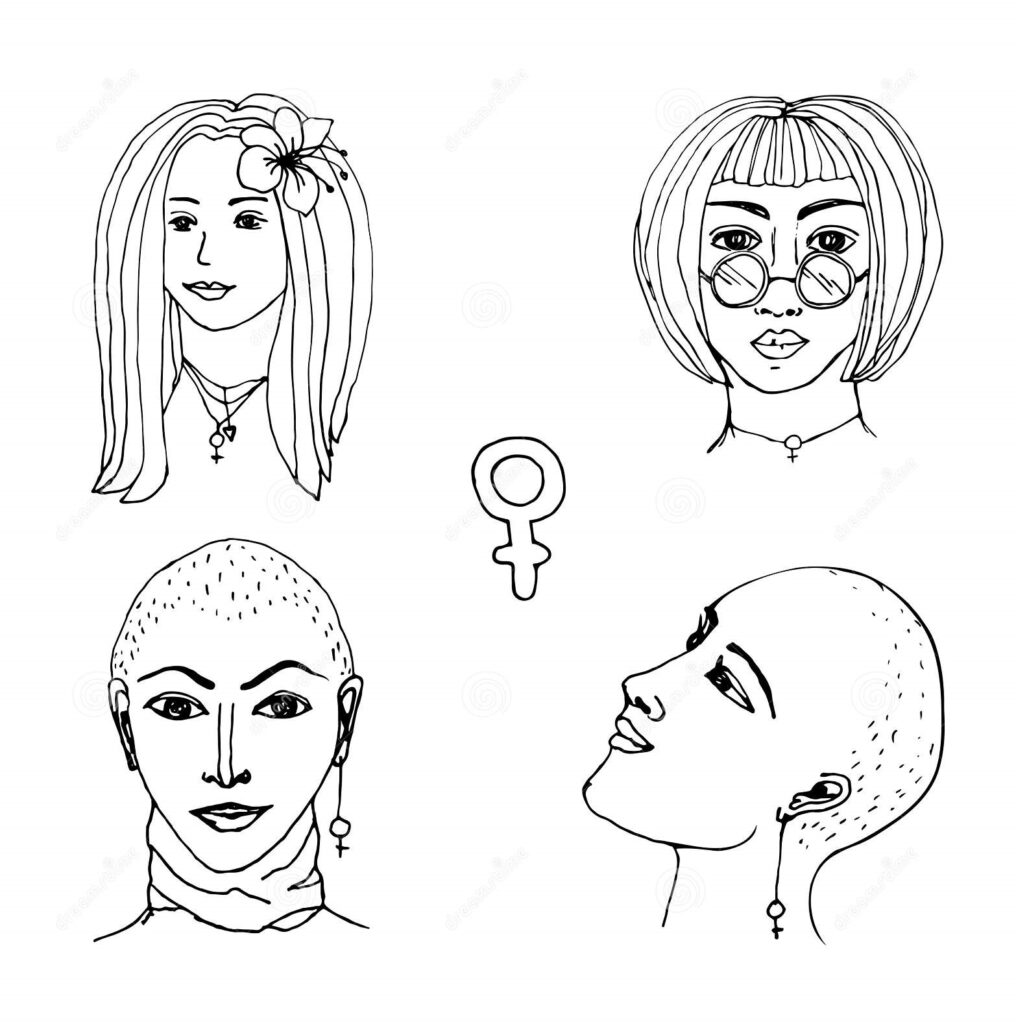
Feminism:
Feminism, a space of political agitations, ideological views, and united social movements that engage a collective goal; to define, establish, and attain equal political, economic, cultural, personal, and social rights for ladies. It comprises demanding to ordain even scopes for women in education and employment. A feminist upholds or assures the rights and equalizing of women.

Oasis of dark age:
In the medieval era of Europe, when catholic churches used to sell a certificate of indulgence, church patronized feudalism used to torture its tenant brutally with the help of some ruthless machines. From 1450 to 1750, in these 300 years, feudalists killed five to seven lakh people in the name of the witch-hunt. Of them, 80% were women.
Europe wanted freedom from this anarchy. Consequently, the ” French Revolution ” took place. Europe entered into a new era, the era of enlightenment. But for women, the situation didn’t change quickly. For them, it was a long way to go. Their effort towards freedom eventually created four historical movements, the waves of feminism.
First wave:

Mary Wollstonecraft, known as the first feminist, wrote a book in 1792. “A Vindication to the Rights of Women” reflected the horrible condition of British women of the eighteenth century.
In Britain and America, for a long time, some feminist activities were going on. The first wave (the title of the timeline) was in the nineteenth century and the early part of the twentieth century. Capitally its main focus was to facilitate man-woman equality, the right to inheritance, and against Chattel Marriage (a legal relationship similar to slavery, where the husband is the owner of wife and children).
At the end of the 19th century, this transformed into a movement to increase the political rights of women. Specifically, in 1848 two hundred women gathered in a church of Newyork. It is known as the Seneca Falls Convention. After discussing woman’s rights and social-citizen-religious issues, they passed 12 regulations. At that time, the feminist movement was going in collaboration with the abolitionist movement. The black woman leaders played the capital role in claiming the suffrage not only for women also for everyone. A former black slave woman Sojourner Truth played a charismatic role in this part of the movement.
But after this, the feminist movement emerged as the movement only for white women. In 1870 by the passing of the 15th amendment passage, black men got the right to vote. Then feminists came to a point. If their former slaves could get the right to vote, Why not they? But the movement became more than only for the right to vote. Equality in the right to education, job, and owning wealth was also their issue.
The first American clinic of birth control commenced in 1916. It came as the first result of the right to giving birth.
In 1920 American congress passed the 19th amendment. The women got suffrage. Mainly after that first wave for then came to an end. Different woman organization kept on protesting in separate issues, but till 1960 there was no collective movement to notice.
Second Wave:
Its timeline is from early 1960 to late 1980. The main focus of it was to eradicate every type of discrimination and establishing equality. Specifically, in 1963 Betty Friedan’s “The Feminine Mystique” got published. The publisher sold 30 lakh copies of it in 3 years. Though Simone de Beauvoir’s “Second Sex” created an enormous response. But the previous book was a revolution. It said mainly child-raising and household work are making a woman frustrated and unhappy. Though the idea wasn’t new, the voice reached 30 lakh, women. A vast number of women discovered, they are not happy. A rising of a movement started. Now the focus isn’t the political equilibrium. It’s social equality. Demands are sexuality and relation, the right of abortion, domestic work-related.

This time the achievement of the movement was-

In the final stage of the movement, it became vulgar in a few ways. It created disinterest and fear in society. Against the men’s mentality towards women, feminists observed a gathering in 1968, where “Miss America” was taking place. They protested by burning their bra. It was a sample of leaving, what is women’s sign in the eyes of men. They wanted the consideration of being recognized as a human, not as a woman.
Third Wave:

Figure 5.Third wave feminism in color.
It started at the starting of 1990. In comparison with the last two, it’s opening is not clear. Mainly the third wave started focusing on two main things, The Anita Hill’s case and the Riot Grrrl group in 1991. Anita Hill did a sexual assault case against his boss. Though the boss got rid of the case, it caused an immense impact on society.
In the House of Representatives, twenty-four women got elected in 1992. It was another political triumph for the feminists.
The second wave called for leaving the symbol of feminity. For that, society didn’t take it nicely. In response to this, the third-wave called to call off the signs of feminity (like- High hill, makeup, ladylike behavior). Capitally, Judith Butler inspired the third wave vastly. The philosophy is, the gender of man-woman is different physically. But gender is not something physical, it is social performative, and it’s the same.

Fourth Wave:
Fourth-wave feminism again resurrected around 2012 in association with the usage of social and popular media. According to Prudence Chamberlain (a renowned feminist scholar), the focal point of it is justice and fairness for women, especially resistance to sexual harassment and ferocity against women. In her writing, she wrote about her wonders about the existence of such attitudes still nowadays towards women.
Kira Cochrane (a British journalist and novelist) has argued to define this movement’s uniqueness. In her opinion, technology immensely prescribes this movement. The use of Facebook, Twitter, You-tube, Instagram, Tumblr, and blogs characterized it specially (like Feministing.com to challenge misogyny). Fourth-wave feminism’s navel chiefly includes harassment in the pathway and workplace, sexual assault at the campus, and the culture of rape.
There are several incidents from 2012. They ignited the flame of the vibrancy:
Footsteps of fourth-wave feminist movements:

Time magazine sort various distinguished female activists engaged in the #Me Too movement. The magazine designated the silence breakers as Person of the Year.
This movement is putting together the women of the current world of 2020. Examples:
Forbes remarks it as A New Wave of Feminist Mobilization.
The Conclusion of Equity:

Figure 8. If feminism is used only against man the equity will be no more.
Victims from the both ends should be helped.
Europe’s dark-age and its effect on women is a historical regret for western civilization. Western women’s right condition is always a challenging condition. But on the other side, men and women are losing the equilibrium for the extremeness of the views. So, a reality check is in need. If we want to ensure social harmony, equity for both sides is required.